


 LinkBack URL
 About LinkBacks
Thank you Luke for this very detailed reporting.Originally Posted by Luke Affalliance

This was indeed also my personal #1 top story from today.
A huge public relation win for the Strava app!
+++ BREAKING NEWS +++
Deep State mole FBI Deputy Director Andrew McCabe resigns!
The release of the conspiracy memo is only a matter of time.
Deep State moles are in panic mode.
Now McCabe betakes himself to flight from the political stage.
He and the others, they know, with that memo, with that cold breath in their neck, perhaps some will put behind bars and must take showers together with two meters tall block ruler El Loco Ramirez.
Not once.
Not twice.
For many years!
Not good.
Or "fantastic" some say.
Leopold
Results 1,861 to 1,880 of 2609
Thread: Leopold's Lucid Daydreams Diary
-
29 January 2018, 1:26 pm #1861
 Public Member
- Join Date
- July 2012
- Location
- Germany
- Posts
- 4,413
- Blog Entries
- 5
- Thanks
- 5,946
- Thanked 6,644 Times in 2,930 Posts

-
The Following 3 Users Say Thank You to Roulette Zeitung For This Useful Post:
Cash Bonus (29 January 2018), Luke Affalliance (30 January 2018), ocreditor (30 January 2018)
-
30 January 2018, 7:54 am #1862
Public Member
- Join Date
- July 2012
- Location
- Germany
- Posts
- 4,413
- Blog Entries
- 5
- Thanks
- 5,946
- Thanked 6,644 Times in 2,930 Posts
Is our world prepared for being a cryptocurrency paradise?
Read this post, tell it your children, your family or friends. Tell them the truth. They deserve to know it.
Water
UN Study: Almost a third of all people, living on this planet, 2,100,000,000+ people, they have no clean drinking water at home. Every 8 seconds a child dies as a result of contaminated water. That means, almost 10 children will die while you are reading this post.
Toilets
WHO Study: Only a fourth of all people, living on this filthy and poisoned planet, have a toilet which is connected to the sewerage system. Almost 1,000,000,000 have no toilet at all.
War
UNHCR Study: More than 65,000,000 people are fleeing from war and violence. On the edge of sheer survival, without shelter, clean water, medical attention, warm clothing or adequate food and completely exposed to the elements.
Hunger
German Agro Action Study: 815,000,000+ people suffering from hunger. Every five seconds, a child dies from hunger-related causes.
Medical treatment
WHO Study: The half of all people, living on this planet, 3,800,000,000+ people, they have no access to medical treatment and application of medication. Every 30 seconds a child dies somewhere in the world due to complications from a malaria infection.
Money
Oxfam Germany Study: 1% of world's population, the richest people, they own 99% of all available assets which are $210,000,000,000,000. Only 60 super rich people owns more than the complete poor half of world's population together.
---
So, I do not believe, that the majority of our world's population, which has no water, no toilets, is suffering from hunger, with no access to medical treatment, with no money and is fleeing from war and violence, is thrilled by new mobile shops in their neighborhood, offering smart phones for the cryptocurrency world. They have indeed other problems, which cannot be resolved with cryptocurrency capitalism.
No, unfortunately this world is not prepared for being a cryptocurrency paradise. For most people it is still the hell on Earth, and with no money, even no toilet, these poor people have simply nothing to trade with. They cannot even buy a piece of bread.
This is also a call to some Bitcoiners, who should act in the public and also in their private life with more respect and decency and less arrogance. And they should not forget, how lucky they are.
Leopold
-
The Following 4 Users Say Thank You to Roulette Zeitung For This Useful Post:
Cash Bonus (30 January 2018), Luke Affalliance (31 January 2018), ocreditor (31 January 2018), Partnerama (2 February 2018)
-
31 January 2018, 5:49 am #1863
Public Member
- Join Date
- July 2012
- Location
- Germany
- Posts
- 4,413
- Blog Entries
- 5
- Thanks
- 5,946
- Thanked 6,644 Times in 2,930 Posts
Volkswagen - Demise of an Era
VW was founded 80 years ago under Adolf Hitler and was one of the most successful car brands ever.
But then, they used emissions-cheating software and lied into the face of their customers.
And now they did, what is unthinkable here in Germany and in many other countries.
Volkswagen initiated cruel animal experiments with apes!
No, not 75 years ago.
Now!
The secret report from the laboratory is shocking!
10 apes, locked up in cages, were forced to breath diesel exhaust for 4 hours in a row!
After this more cruel experiments with endoscopes were done.
Dr. Frankenstein and his VW rabble showed the tortured apes cartoon movies during that 4 hours of torture, so that they could "relax".
Leopold
-
The Following 3 Users Say Thank You to Roulette Zeitung For This Useful Post:
Cash Bonus (31 January 2018), Luke Affalliance (31 January 2018), ocreditor (31 January 2018)
-
1 February 2018, 4:39 am #1864
Private Member
- Join Date
- May 2014
- Posts
- 5,450
- Thanks
- 9,148
- Thanked 3,003 Times in 2,215 Posts
Hello Leopold, Ocreditor, Shay, Josy (where are you, Josy? We miss you terribly at the GPWA) and the rest of the gang!

I just wanted to share some stunning images of the 'Super Blue Blood Moon' that has just passed.
I'm sure that you're going to love them.
Life really is amazing and breathtaking isn't it?
Ocreditor, you're in for a treat my friend
‘Super blue blood moon’ stuns stargazers across Australia
SKYGAZERS around the world got a rare cosmic treat as a total lunar eclipse created a “super blue blood moon” last night. Here are the breathtaking photos from Norway, to London and beyond.
STARGAZERS across large swathes of the globe — from the streets of Los Angeles to the slopes of a smouldering Philippine volcano — had the chance to witness a rare “super blue blood Moon” on Wednesday, when the earth’s shadow bathed our satellite in a coppery hue.
The celestial show was the result of the sun, earth, and moon lining up perfectly for a lunar eclipse just as the moon is near its closest orbit point to earth, making it appear “super” large.
Australia, Hawaii and Alaska had the best seats, along with the Canadian Yukon and Asia. The western US also had good viewing, along with Russia.
Here is the link for you guys to continue reading it on from there. You will love it. I promise you.
http://www.news.com.au/technology/sc...a78c1d27934d31
The next 'Super Blue Blood Moon' will not happen next until the year 2037! That's just too far away. Lol.
Anyway, enough of me talking on... Please, enjoy!
-
The Following 2 Users Say Thank You to Cash Bonus For This Useful Post:
ocreditor (1 February 2018), Roulette Zeitung (1 February 2018)
-
1 February 2018, 12:40 pm #1865
Public Member
- Join Date
- July 2012
- Location
- Germany
- Posts
- 4,413
- Blog Entries
- 5
- Thanks
- 5,946
- Thanked 6,644 Times in 2,930 Posts
Yes Eissa, this was a wonderful event. Image, what our ancestors might have thought or did when they saw a Blue Moon. I mean, at that time everything was a little bit looser than today, right?
Perhaps, during the Blue Moon nights, they held some people's heads under water, the "winners", who were persuaded by the medicine man to take part in the "Mr. Moon" competition. Heads under water, directly at the sacrificial altar in front of a raucous crowd, until they turned blue, in honor of the gods.
After that, free beer and free babes.
You see, it wasn't all bad at the time.
Leopold
-
The Following 3 Users Say Thank You to Roulette Zeitung For This Useful Post:
Cash Bonus (1 February 2018), Luke Affalliance (2 February 2018), ocreditor (4 February 2018)
-
2 February 2018, 7:31 am #1866
Public Member
- Join Date
- July 2012
- Location
- Germany
- Posts
- 4,413
- Blog Entries
- 5
- Thanks
- 5,946
- Thanked 6,644 Times in 2,930 Posts
The Polka King
My personal Netflix pick of the month!
This is really a very nice, fine movie about the probably most charming Ponzi-Scheme artist ever in the USA, a Polish immigrant and band leader, the "Polka King" of Pennsylvania.
And it's a true story!
Us usual, first watch the movie, after that search on Google for him. So you don't have a spoiler.
And after you watched the movie, you can also search on Netflix for the documentation "The Man Who Would Be Polka King". Then you can see the guy in real life and his story from the perspective of him, his friends and the "investors". Perhaps it's still available also on your Netflix.
Leopold
-
The Following 4 Users Say Thank You to Roulette Zeitung For This Useful Post:
CarmelS (5 February 2018), Cash Bonus (2 February 2018), Luke Affalliance (3 February 2018), ocreditor (4 February 2018)
-
2 February 2018, 2:43 pm #1867
Public Member
- Join Date
- July 2012
- Location
- Germany
- Posts
- 4,413
- Blog Entries
- 5
- Thanks
- 5,946
- Thanked 6,644 Times in 2,930 Posts
Counter statement
The same GPWA member, who falsely claims, that GPWA is funded by exactly the same sponsors as IGB is, now falsely claims, that I am promoting the Martingale system.
Fact check: In this article about the Martingale system, which has already 88.795 views* and which is the most viewed article on my website, I expressly warn the readers about the use of the Martingale system and how the promotion of many casino websites, abusing the Martingale promotion, lures players into the online casino with the false promise, that the Martingale is an allegedly infallible "Roulette Trick".
In another article about the "Roulette Number Software" with 7.676 views*, a software that is available in different languages**, this software I am debunking in all details, with detailed tables about every step of this Martingale progression, that is adapted to single numbers. Calculations of all 185 possible steps of the progression in all details, tables for the progression steps, the bets, the winnings if there is a hit and the losses after each step. It ends up with a total loss of 3551 units. This article is also a warning of using the Martingale system.
I am also referring and linking on my website to other articles, that are also warning about the Martingale.
So the claim, I of all people would promote the Martingale system is either a deliberate lie or the result of fake news or identity theft.
Leopold
* If you scroll down my main page to the bottom ( http://www.roulettezeitung.com ), then you'll see at the right the view numbers. The results are not fabricated. The results are real and the data is generated with the "Wordpress Popular Posts" plugin ( https://de.wordpress.org/plugins/wor...popular-posts/ ).
** roulettenumber.com
-
The Following 2 Users Say Thank You to Roulette Zeitung For This Useful Post:
Cash Bonus (2 February 2018), ocreditor (4 February 2018)
-
2 February 2018, 10:39 pm #1868
Private Member
- Join Date
- May 2014
- Posts
- 5,450
- Thanks
- 9,148
- Thanked 3,003 Times in 2,215 Posts
Hello Leopold, Ocreditor, Shay, Josy (where is Josy? She has not been seen here on the GPWA since January 11), Luke AffAlliance, Phil AffAlliance and the rest of my good friends here at the GPWA.
How are you all going?
I just wanted to share another story of space with you guys. This is a very interesting one, and I'm surethatOcreditor will like it the most.
I have always loved space ever since I can remember, It's always fascinated me and blown my mind. I bet that there's still so much for us humans to learn, that we really haven't even started to scratch the surface yet. We've still got a long way to go.
Anyway, on to the story for you and here it is. I hope that you will enjoy this story, just like the other ones.
Why space radiation won’t stop human space exploration
Space radiation effects – from solar storms and, even more importantly, from galactic cosmic rays – are known to be harmful to astronauts exploring beyond Earth’s protective magnetic field. The most important potential negative health effect is cancer, but there’s also evidence for cataracts and damage to the cardiovascular and central nervous system from space radiation. NASA has been exploring potential physical, biological and operational countermeasures. The short video above – released by NASA on October 12, 2017 – talks specifically about space radiation and the journey to Mars. Pat Troutman, NASA Human Exploration Strategic Analysis Lead, commented in the video above:
If you want more about NASA’s current understanding of space radiation as it relates to the human exploration of space, watch the 1-hour video below. It’s a recorded talk from October 9, 2017 by Jack Miller of Lawrence Berkeley National Laboratory, Berkeley, California. Miller has a Ph.D. in experimental relativistic heavy ion physics from the Lawrence Berkeley National Laboratory Bevalac. His research interests have included: interactions of galactic cosmic radiation and solar particles in matter and biological organisms, with applications to mitigation of radiation effects on humans in space; experimental tests of nuclear fragmentation and transport models; development of spacecraft and habitat radiation shielding; and development of radiation instrumentation for use in human space flight. The talk is called Space Radiation and its Impact on Human Exploration of the Solar System. You’ll find an extended bio for Jack Miller here.
Some people think that radiation will keep NASA from sending people to Mars, but that’s not the current situation. When we add the various mitigation techniques up, we are optimistic it will lead to a successful Mars mission with a healthy crew that will live a very long and productive life after they return to Earth.
Last edited by Cash Bonus; 2 February 2018 at 11:05 pm.
-
The Following 2 Users Say Thank You to Cash Bonus For This Useful Post:
ocreditor (4 February 2018), Roulette Zeitung (3 February 2018)
-
4 February 2018, 5:20 am #1869
Private Member

- Join Date
- April 2009
- Location
- Israel
- Posts
- 7,354
- Blog Entries
- 1
- Thanks
- 7,103
- Thanked 4,342 Times in 2,835 Posts
Saw it - very good indeed ! Originally Posted by Roulette Zeitung
-
The Following 2 Users Say Thank You to ocreditor For This Useful Post:
Cash Bonus (4 February 2018), Roulette Zeitung (4 February 2018)
-
4 February 2018, 11:29 am #1870
Public Member
- Join Date
- July 2012
- Location
- Germany
- Posts
- 4,413
- Blog Entries
- 5
- Thanks
- 5,946
- Thanked 6,644 Times in 2,930 Posts
The countdown is running for the biggest show on Earth!
La la lac 2018
50,000+ delegates from 218 countries fight for the grace of the remaining 1,876 affiliates who still stand tall.
What a gigantic show!
Places you should not miss:
GPWA
After you will run with foam at the mouth into the hall as if this is a 1$-Shop, immediately pull the brake, because GPWA is at the left next to the door at stand L22, and only Pangea Translation booth can protect them from getting a tinnitus due to the pleasure screams of some obsessed visitors.

Rewards Affiliates
If you urgently need some eggnog, and this will be the case latest after the first session in a conference room, then Renee and Celia will be your host at stand B57.

Leopold
-
-
5 February 2018, 3:28 am #1871
Non-sponsor Affiliate Program
- Join Date
- May 2017
- Posts
- 127
- Thanks
- 161
- Thanked 318 Times in 103 Posts
Hey Leopold,
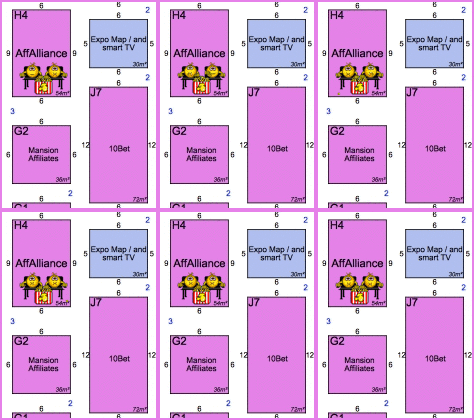
Don't forget about me, I'll also be very happy to say hi to anyone who comes to visit me at booth H4 =)

Cheers
-
The Following 2 Users Say Thank You to Luke Affalliance For This Useful Post:
ocreditor (5 February 2018), Roulette Zeitung (5 February 2018)
-
5 February 2018, 3:45 am #1872
Private Member
- Join Date
- January 2015
- Posts
- 2,872
- Thanks
- 2,043
- Thanked 2,446 Times in 1,324 Posts
That seems to be quite a big booth. More than half of 10Bet and they usually do have a big booth at this events.
-
The Following 3 Users Say Thank You to Triple7 For This Useful Post:
Cash Bonus (5 February 2018), ocreditor (5 February 2018), Roulette Zeitung (5 February 2018)
-
5 February 2018, 4:53 am #1873
Private Member
- Join Date
- April 2009
- Location
- Israel
- Posts
- 7,354
- Blog Entries
- 1
- Thanks
- 7,103
- Thanked 4,342 Times in 2,835 Posts
I'll come to say hi for sure Originally Posted by Luke Affalliance
-
The Following 2 Users Say Thank You to ocreditor For This Useful Post:
Cash Bonus (5 February 2018), Roulette Zeitung (5 February 2018)
-
5 February 2018, 5:25 am #1874
Non-sponsor Affiliate Program
- Join Date
- May 2017
- Posts
- 127
- Thanks
- 161
- Thanked 318 Times in 103 Posts
Since it's our first show, we wanted to make something special Originally Posted by Triple7
. Are you coming?
Ocreditor It would be great to meet you there. =)
-
The Following User Says Thank You to Luke Affalliance For This Useful Post:
Roulette Zeitung (5 February 2018)
-
5 February 2018, 5:31 am #1875
Public Member
- Join Date
- July 2012
- Location
- Germany
- Posts
- 4,413
- Blog Entries
- 5
- Thanks
- 5,946
- Thanked 6,644 Times in 2,930 Posts
Originally Posted by Luke Affalliance
Originally Posted by Luke Affalliance
Originally Posted by ocreditor
That means, enough space for a popcorn chill out, a gigantic smart TV, dance performance by some sweet Bunny Girls, and - for the older of us - Luke will serve in the separated left back corner of the booth cake and coffee, and he personally will also spin the Bingo cage, while an accordion player performs shanty songs. Originally Posted by Triple7
Leopold
-
The Following 2 Users Say Thank You to Roulette Zeitung For This Useful Post:
Luke Affalliance (5 February 2018), ocreditor (6 February 2018)
-
5 February 2018, 5:40 am #1876
Non-sponsor Affiliate Program
- Join Date
- May 2017
- Posts
- 127
- Thanks
- 161
- Thanked 318 Times in 103 Posts
Originally Posted by Roulette Zeitung
Heeeeey, spoiler alert =))
Can't say much now, but bunny girls and gigantic screen are on the list
-
The Following User Says Thank You to Luke Affalliance For This Useful Post:
Roulette Zeitung (5 February 2018)
-
5 February 2018, 5:45 am #1877
Non-sponsor Affiliate Program
- Join Date
- April 2009
- Location
- Malta
- Posts
- 146
- Thanks
- 52
- Thanked 64 Times in 35 Posts
OMG all this on the 1st LAC I'm missing in 8 years

-
The Following User Says Thank You to CarmelS For This Useful Post:
Roulette Zeitung (5 February 2018)
-
6 February 2018, 2:34 am #1878
Private Member
- Join Date
- May 2014
- Posts
- 5,450
- Thanks
- 9,148
- Thanked 3,003 Times in 2,215 Posts
Hello Leopold, Ocreditor, Shay, Josy, Luke and friends,
How are you all?
Today, I am not happy at all. I am very disappointed and I am feeling quite stressed about things It seems that life is just getting harder and harder every day and nobody seems to care. I am having so many problems, I don't even know where to begin. I just wish that things would improve and that we, as affiliates, would be listened to more, never ignored and to be taken more seriously whenever we encounter any sort of trouble. Be it any sort of trouble that comes along our way.
I just want to thank all of the good people who make the world a better and more acceptable place to live in.
Thank you for taking the time to listen to me.
Last edited by Cash Bonus; 6 February 2018 at 4:10 am.
-
The Following User Says Thank You to Cash Bonus For This Useful Post:
Roulette Zeitung (6 February 2018)
-
6 February 2018, 4:07 am #1879
Non-sponsor Affiliate Program
- Join Date
- May 2017
- Posts
- 127
- Thanks
- 161
- Thanked 318 Times in 103 Posts
Hey Vtyunby65,
Life can be tough sometimes no matter if you are affiliate, affiliate manager, middle chain manager or a catholic priest. To tell the truth, I don't have an effective strategy to tackle those emotional issues. The best thing, I guess, would be to take time to care about yourself. Say something pleasant to yourself and go for a walk in the nearby park with some meditative music in your ear. This should help. If you have a friend with a dog - borrow it for a walk. Good Boy Doggo never fails.
Something we forgot about yesterday.
The Berlin Wall fell 10,316 days ago, the same amount of time it stood as a dispiriting Cold War symbol

The Berlin Wall, the ultimate symbol of the dehumanizing nature of Soviet communism, came down on Nov. 9, 1989. That means as of today, Feb. 5, 2018, to the amazement of anyone old enough to have seen its destruction, the barrier has now been debris for as long as it stood -- 10,316 days.
In 1945, the capital of Adolf Hitler's defeated Third Reich was divided between U.S., British, French and Russian occupation zones for temporary postwar military rule. As the wartime alliance between the Western countries and the Russians collapsed into Cold War conflict, the division between West Berlin and East Berlin became permanent, with the former belonging to democratic West Germany and the latter part of a totalitarian state modeled on the Soviet regime.
In August 1961, with about 1,000 of its citizens fleeing over the border every day, East Germany laid down barbed wire and began building a wall to physically separate the two sides of the city.
During the wall's 28 years of existence, many desperate East Germans risked their lives to escape around, over or through it. Indeed, more than 100 of them were killed attempting to overcome the six-foot-high, 96-mile-long, barbed-wire-topped concrete panels.
East German citizens secretly dug tunnels under the wall. A former circus performer tightrope-walked across an out-of-service power cable.
An East German solider smashed a tank into the wall. The barrier held, but the soldier managed to successfully scramble over the wall, despite being shot twice by East German guards.
A man named Holger Bethke used a bow and arrow to send a wire cable over the wall, where his brother, who had escaped to the West nearly a decade before, secured it. Bethke then shimmied along the wire to freedom.
Then, with the Soviet bloc collapsing, the Berlin border suddenly opened in 1989. Citizens of both sides of the city began joyously hacking at the wall, and the world as everyone knew it changed.
"The history books say the Wall opened on one strange night in November of that year, but that's not quite right," wrote Marc Fisher, the Washington Post's Berlin bureau chief in 1989. "It was really a process that took several months, a process that consisted of the physical deconstruction of the wall, countless changes in people's daily routines, and a mental shift that was perhaps the biggest hurdle of all."
That mental shift among Berliners long since has been completed, but the wall still remains -- in the history books, sure, but also in the emotional and ideological landscape of both Berlin and the wider world.
Source
-
The Following User Says Thank You to Luke Affalliance For This Useful Post:
Roulette Zeitung (6 February 2018)
-
6 February 2018, 11:21 am #1880
Public Member
- Join Date
- July 2012
- Location
- Germany
- Posts
- 4,413
- Blog Entries
- 5
- Thanks
- 5,946
- Thanked 6,644 Times in 2,930 Posts
Thank you very much Luke for this report. A lot of memories returns.
The youth today, they can't even imagine, how this one single Wall presented the Cold War like nothing else.
"The history books say the Wall opened on one strange night in November of that year, but that's not quite right," wrote Marc Fisher, the Washington Post's Berlin bureau chief in 1989. "It was really a process that took several months, a process that consisted of the physical deconstruction of the wall, countless changes in people's daily routines, and a mental shift that was perhaps the biggest hurdle of all."
Yes, for many, many months masses of peaceful protesters all over the GDR flooded the streets day and night and shouted "We are the people! ... We are the people!"
It was Guenter Schabowski (†86), former spokesman for the East German regime, who teared the Wall finally down, and he did it not with intent.

In the early evening of 9. November 1989 Schabowski held a press conference.
GDR collapsing in free fall speed, the spokesman surprisingly announced, that at once "private trips to foreign countries can be applied for without any prerequisites, travel arrangements and relationships. The permits will be issued shortly. The competent departments of the police district offices in the GDR are instructed to issue visas for permanent departure without the need for valid conditions for a permanent departure. Permanent departures can be made via all border crossing points of the GDR to the Federal Republic of Germany."
"Permanent departures can be made via all border crossing points of the GDR to the Federal Republic of Germany."
Journalists couldn't believe, what they just heard.
One of them asked: “When does it take effect?”
Schabowski paused for some seconds in total confuse mode and then he said that historical words, that finally teared down the Wall:
"To my knowledge - Immediately. Without delay."
This amazing news spread like wildfire. Minutes later the first people in the GDR ran to the Wall checkpoints and demanded a free passage to West Berlin. After already one hour thousands of people were standing at the checkpoints and shouted "We want out! We want out!"
Heartbreaking scenes were going on. The armed GDR guards at the Wall tried to contact their leaders for instructions over the telephone, but no one picked up the phone. They were so desperate. Then without direct orders, guard officers lifted the barriers and let the people go into their freedom. Not a single bullet was fired. No one was beaten down.
The unbelievable truth: This all happened by accident, because Schabowski by accident said "To my knowledge - Immediately. Without delay.". The memo, the complete content of that press conference was dedicated to be read the next day deep in the night at 4:00, when everyone would sleep. Schabowski by accident read the memo the day before at 18:00 in the evening, when everyone heard of it within minutes.
This is the true story, how one guy from the dictator regime by accident opened the Wall and so finished the Cold War.
LeopoldLast edited by Roulette Zeitung; 6 February 2018 at 11:26 am.
-
The Following User Says Thank You to Roulette Zeitung For This Useful Post:
Luke Affalliance (6 February 2018)


 Reply With Quote
 Posting Permissions